
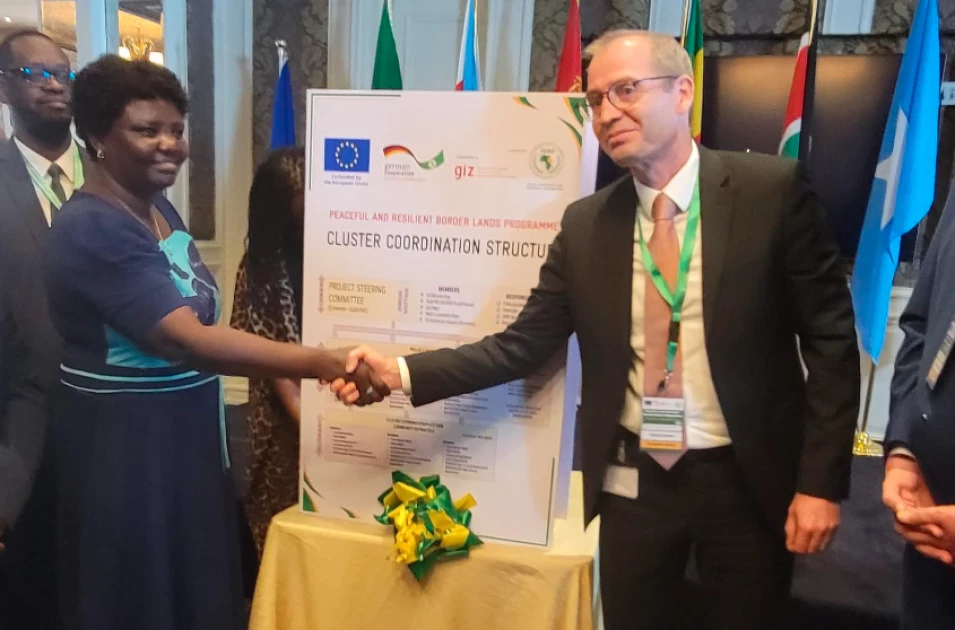
The Intergovernmental Authority on Development (IGAD) has officially launched the Peaceful and Resilient Borderlands Programme in a significant move aimed at promoting peace, resilience, and sustainable development in the Horn of Africa.The initiative, co-funded by the European Union and Germany, was unveiled during an event in Nairobi, with high-level government officials, ambassadors, and representatives of development partners in attendance.
The programme seeks to address conflict prevention and enhance socio-economic development in cross-border regions that have historically suffered from resource-based conflicts exacerbated by climate change. It focuses on three key IGAD clusters: Karamoja, Mandera, and Moyale.
Speaking at the event, Kenya's Cabinet Secretary for the Ministry of East African Community, Arid and Semi-Arid Lands (ASALs), and Regional Development Beatrice Askul Moe highlighted the importance of this initiative.
Moe noted that the Horn of Africa has been hit hard by adverse climate events like droughts and floods, which have triggered resource-based conflicts and displacements, further compounding the humanitarian crises in these regions.
The programme, which aligns with the IGAD Drought Disaster Resilience and Sustainability Initiative (IDDRSI), aims to foster peaceful coexistence among cross-border communities by strengthening governance structures and building mechanisms to withstand shocks like droughts and conflicts.
"Peace and resilience are inseparable pillars upon which sustainable development can flourish," said Moe. She also acknowledged the role of pastoral communities in Kenya’s border regions, stressing that these areas, though often fragile, are home to communities that share common cultural, linguistic, and economic ties across borders.
Mohamed Ware, IGAD’s Deputy Executive Secretary, echoed these sentiments in his address, calling for a paradigm shift in the perception of the arid and semi-arid lands (ASALs).
"It is time to change the narrative that views the ASALs and their cross-border communities as peripheral. Instead, we must recognize and leverage these communities as bridges for transformative change and development," said Ware. He noted that ASALs cover 70% of the region’s land mass and are home to more than 100 million people, along with 532 million livestock, which contributes up to 50% of the agricultural GDP.
Ware also highlighted the socio-economic potential of ASALs, urging leaders to see these regions not as marginalized areas but as vital economic zones. "Economic integration and trade facilitation are crucial for the development of cross-border communities. By improving infrastructure, streamlining border management procedures, and promoting cross-border trade, these regions can unlock their economic potential," he added.
The Peaceful and Resilient Borderlands Programme aligns with the African Union’s Niamey Convention on borderland management, emphasizing the need for peaceful and cooperative governance of border areas. It also builds on IGAD’s framework for cross-border cooperation, with a strong focus on economic integration, social cohesion, and sustainable resource management.
She also pointed out that Kenya is actively working with neighboring countries to foster peace and development, with agreements already in place with Uganda, Ethiopia, and plans to initiate similar agreements with Somalia and South Sudan.
In closing, Ware reaffirmed IGAD's commitment to seeing the programme through to its full implementation. "Let us promote the cross-border communities as bridges that connect us, fostering economic growth, social cohesion, and environmental sustainability. Through the collective efforts of our governments, development partners, and local communities, we can create a resilient and prosperous IGAD region," he said.