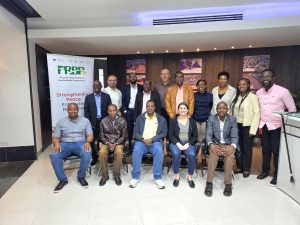
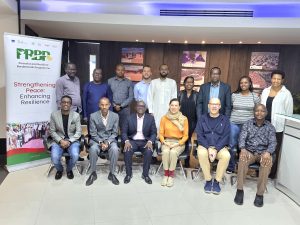
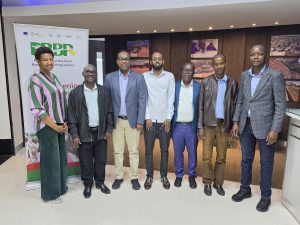
Nairobi, Kenya – 03 July 2026: Strengthened cross-border coordination, improved conflict prevention systems, enhanced use of early warning and anticipatory action tools, as well as stronger partnerships among communities, governments, and development actors are among the key expected outcomes of a newly inducted team of Cross-Border Development Facilitation Unit (CBDFU) Coordinators.
The coordinators were inducted under the IGAD Drought Disaster Resilience and Sustainability Initiative (IDDRSI) with support from the European Union through GIZ’s Regional Transformation Cluster, Peaceful and Resilient Borderlands Programme (PRBP). The coordinators will serve across the Karamoja, Mandera and Moyale clusters spanning the borders of Kenya, Uganda, Ethiopia and Somalia. Their role will be to strengthen collaboration among communities, local authorities, technical institutions and development partners while supporting conflict prevention, resilience building and cross-border development initiatives.
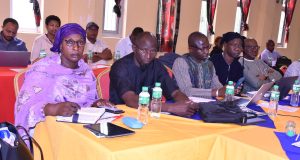
To prepare them for this responsibility, the Intergovernmental Authority on Development (IGAD), through its specialized institutions and partners, convened a five-day induction programme bringing together representatives from IDDRSI, CEWARN, ICPAC, and ICPALD, alongside development partner GIZ and implementing partners Danish Church Aid (DCA), Danish Refugee Council (DRC) and Life & Peace Institute (LPI). The induction was also attended by representatives from the Food and Agriculture Organization of the United Nations (FAO) and the European Union Delegation to Kenya, reaffirming their commitment to supporting integrated approaches to peacebuilding, resilience, climate adaptation, livestock development and sustainable cross-border governance across the three clusters.
Opening the induction, Mubarak Mabuya, IGAD's IDDRSI Platform Coordinator, underscored the importance of borderlands as engines of regional integration and development. "Borderlands are not peripheral spaces; they are centres of opportunity, trade, cultural exchange and regional integration. The CBDFU framework strengthens our ability to coordinate development and peacebuilding efforts across borders while ensuring that communities remain at the centre of decision-making. Through this initiative, IGAD is strengthening local ownership of resilience and creating stronger linkages between regional policies and community action," he said.
The induction equipped coordinators with knowledge and practical tools on cross-border conflict prevention and management, oversight of Technical Working Groups, early warning and anticipatory action systems, transboundary animal health coordination, communications, visibility and stakeholder engagement. The CBDFU serves as a critical cross-border coordination mechanism within the PRBP architecture. As frontline facilitators, the coordinators will help translate regional frameworks into local action by strengthening collaboration between governments, communities and development partners and ensuring that community priorities inform cross-border programming.
According to Katharina Hübner, GIZ Regional Transformation Cluster Manager, the initiative lays out the foundation for a new generation of cross-border practitioners capable of connecting peacebuilding with sustainable development outcomes. "The complexity of borderland challenges requires coordinated and innovative approaches. Through the CBDFU structure, we are investing in people and institutions that can bring together governments, communities, technical experts and development partners around shared solutions. We expect the coordinators to become catalysts for collaboration, learning and long-term resilience across the programme clusters," she said.
A key feature of the induction was learning from the successful Moyale Conflict Prevention and Resolution Mechanism (CPMR), which has emerged as a model for community-led cross-border peacebuilding in the IGAD region. Supported by IGAD CEWARN, GIZ and local partners, the Moyale peace structure brought together previously fragmented peace initiatives into a unified platform that strengthened cooperation between communities and authorities on both sides of the Kenya-Ethiopia border. The mechanism has successfully mediated inter-community disputes, facilitated the recovery of stolen property across borders, reduced tensions around contested resources, and strengthened trust in local conflict management structures.
Reflecting on the model's success, Dr Bedru Muzein, the Project Component Manager, Cross Border Cooperation at GIZ, who played a leading role in the design and operationalization of both the CPMR and CBDFU approaches under the Strengthening IGAD’s Migration Policy Implementation Project (SIMPI) programme, highlighted the value of institutionalizing local peace structures. "The CPMR model demonstrated that when communities, governments and regional institutions come together under a coordinated framework, they can effectively address the root causes of conflict and build lasting peace. The CBDFU model builds on this success by ensuring that peace, development and resilience interventions are coordinated, inclusive and sustainable," he noted.
Lessons from Moyale will guide the establishment and strengthening of similar Conflict Prevention, Management and Resolution platforms in Karamoja and Mandera, adapted to each cluster's unique conflict dynamics, climate risks and development challenges. For Galma Dida, CBDFU Coordinator for the Moyale Cluster, the training offered an opportunity to share lessons from a region where collaborative peacebuilding is already yielding results. "Moyale has shown that communities can become the first line of defense against conflict when they are empowered, organized and supported. The CBDFU will strengthen these connections further by improving coordination among local peace structures, government institutions and development actors," he said.
Participants also explored how climate information, early warning systems, anticipatory action, and transboundary animal disease surveillance can be integrated into local planning and decision-making processes. Speaking on behalf of the Karamoja Cluster, Dr Gerald Kairu noted that the induction provided practical tools for addressing shared challenges across the Kenya-Uganda border. "Karamoja experiences interconnected challenges that cannot be addressed by one country or one institution alone. This induction has equipped us with practical tools and regional experiences that will help strengthen cross-border coordination and promote community-driven solutions for peace and resilience," he said.
Similarly, Omar Siraji, CBDFU Coordinator for the Mandera Cluster, emphasized the importance of partnerships in a region where security, mobility, and development issues are cut across borders. "Through the CBDFU approach, we have an opportunity to strengthen trust among communities, improve collaboration between institutions and support initiatives that promote stability, livelihoods and social cohesion across the Kenya-Ethiopia-Somalia borderlands," he said.
Participants welcomed the engagement of FAO and the European Union Delegation to Kenya, whose support is expected to strengthen the work of the CBDFUs through enhanced technical collaboration, policy engagement and investments in resilience-building initiatives. FAO's expertise in livestock systems, transboundary animal disease management and sustainable natural resource management, alongside the European Union's longstanding support for regional integration, peacebuilding and resilience programming in the Horn of Africa, will be instrumental in helping the coordinators translate regional frameworks into tangible benefits for communities across Karamoja, Mandera and Moyale.
As the Peaceful and Resilient Borderlands Programme advances implementation across the three clusters, the newly inducted coordinators are expected to strengthen Technical Working Groups, support operationalization of cross-border governance structures, facilitate community engagement and ensure that local voices inform regional decision-making.
The induction reaffirmed the commitment of IGAD, GIZ, DCA, DRC, LPI, member states and local stakeholders to transform borderlands from areas often associated with vulnerability and conflict into spaces of cooperation, resilience, opportunity and sustainable development.
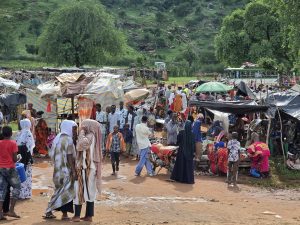
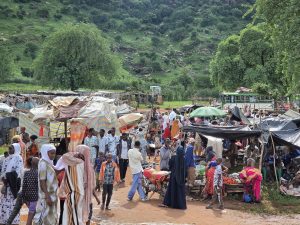
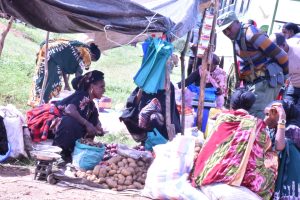
At sunrise in Dukana, the mudy border between Ethiopia and Kenya slowly comes alive. Women arrange grains and handmade goods under makeshift stalls, greeting customers in a mix of Borana, Amharic, and Swahili. There is no tension here, only trade, laughter, and quiet determination.
For many like Halima Guyo, a cross-border trader from Moyale, this scene was once unimaginable. “Before, we feared crossing,” she says. “There were conflicts, and we didn’t know who to trust. Today, I sell my goods on both sides. I earn more, and my children go to school.” Halima’s story reflects a broader transformation taking place along the Ethiopia–Kenya border, one shaped by deliberate cooperation between communities, governments, and regional institutions under the African Union Commission (AUC) and Intergovernmental Authority on Development (IGAD) Joint Action Plan on border governance.
From Fragile Borders to Shared Opportunities
For years, the Moyale borderlands were marked by recurring conflict, limited coordination between authorities, and weak peace structures. However, through the efforts of the African Union Commission (AUC), IGAD’s Conflict Early Warning and Response Mechanism (CEWARN), and support from GIZ and other partners, a new approach has taken root—one that views borders not as dividing lines, but as shared spaces of opportunity. Central to this transformation are the Cross-Border Peace Committees and the Conflict Prevention, Management and Resolution (CPMR) platforms. Bringing together community leaders, government representatives, and civil society actors from both Kenya and Ethiopia, these platforms have become the backbone of local peacebuilding efforts. “We have moved from reacting to conflict, to preventing it,” explains Edward Goko, Deputy County Commissioner on the Moyale-Kenya side. “Through regular dialogue and joint planning, we address issues before they escalate,” he noted. The impact is already visible: cross-border tensions have reduced, coordination between Ethiopian and Kenyan authorities has improved, and joint initiatives such as the Dukale cross-border market are fostering economic interdependence and strengthening peaceful coexistence.
Strengthening cross-border coordination.
Working closely with IGAD-CEWARN, the African Union Border Programme (AUBP), and national and local authorities, GIZ, through the Strengthening IGAD Migration Policy Implementation II (SIMPI II) and Strengthening IGAD’s Capacity to Increase Resilience in the Horn of Africa (SCIDA III) programmes, has supported the operationalization of Cross-Border Facilitation Units (CBDFUs) as coordination hubs along the Ethiopia–Kenya border. These hubs have created a shared framework that brings together government actors, CPMR platforms, civil society organizations, and development partners to strengthen cross-border cooperation and coordination.
The establishment of the CBDFUs has significantly reduced fragmentation among stakeholders by aligning priorities and ensuring that cross-border initiatives are implemented as part of a coherent regional strategy rather than in isolation. The approach has encouraged joint planning, collaboration, and collective learning among actors operating across the borderlands. “Stakeholders’ inclusion has helped us sit at one table,” notes Dida Galma, an IGAD CBDFU official in Moyale. “Before, actors worked in parallel. Now, we plan together, implement together, and learn together.”
Through the Peaceful and Resilient Borderlands Programme (PRBP), GIZ has further provided technical support to strengthen the capacity of CPMR platforms, facilitate structured dialogue among the Moyale, Mandera, and Karamoja clusters, and connect local peacebuilding initiatives to regional policy frameworks such as the Niamey Convention. This support has enhanced collaboration across different governance levels while reinforcing mechanisms for conflict prevention, peacebuilding, and resilience.
This multi-level coordination approach, linking community voices to regional decision-making processes, has been instrumental in translating policy into practical action on the ground. By fostering stronger institutional linkages and inclusive cooperation, the programme has helped build more sustainable systems for cross-border governance and peacebuilding. “Our role is to connect the dots between communities, governments, and regional institutions, so that cooperation becomes systematic, inclusive, and sustainable, while offering technical support to the programmes,” noted Dr. Bedru Muzein, GIZ’s Head of Component.
Peace Restored in Sololo–Miyo: From Conflict to Coexistence.
The impact of sustained peacebuilding efforts is equally evident along the Sololo–Miyo border, a region that endured more than 35 years of intermittent conflict between communities in Ethiopia and Kenya. For decades, insecurity disrupted livelihoods, weakened social cohesion, and fractured cross-border relations, while key economic hubs such as the Dukane market struggled to function due to recurring clashes and deep-rooted mistrust. Today, however, that narrative is gradually changing. Through strengthened cross-border cooperation, revitalized CPMR platforms, and community-led peace structures supported by IGAD, the African Union Commission (AUC), and development partners, Sololo–Miyo is experiencing a renewed period of peaceful coexistence and collaboration.
The reopening and steady operation of the Dukane market has become a powerful symbol of restored trust, resilience, and economic recovery in the borderlands. Communities that once viewed one another with suspicion are now trading, interacting, and rebuilding shared livelihoods across the border. Reflecting on this transformation, Mr. Dabassa Dambi, Chairperson of the Cross-Border Committee from Sololo, noted: “We have seen what conflict does, it takes everything. Now we choose peace, because we see what it brings back.”
Learning Across Borders: From West Africa to East Africa.
A turning point came in April 2025, when representatives from Moyale and Sololo travelled to the Mali–Guinea border to learn from well-established cross-border cooperation models in West Africa. The exchange visit exposed participants to functioning systems of joint development planning, shared financing mechanisms, and locally driven governance structures that have strengthened peace and cooperation across borders. “The experience in West Africa showed us what is possible when communities are at the centre,” said Calmus Omogo, Director for IGAD CEWARN. “We saw functioning joint development plans, shared financing mechanisms, and strong local ownership.”
Back in Moyale, these lessons are already being adapted to the local context. Cooperation among stakeholders has strengthened, and there is growing momentum to institutionalize frameworks similar to West Africa’s Local Cross-Border Cooperation Groupings. According to AUBP representative Daniel Azene, “The Niamey Convention provides the legal foundation, but it is through initiatives like this that we see it come to life through people, partnerships, and practical action.”
Women at the Heart of Peace and Prosperity.
One of the most significant outcomes of the initiative has been the empowerment of women engaged in cross-border trade through the Building Foundations for Sustainable Peace (BFSP) approach implemented by Strategies for Northern Development (SND) Organization. In Moyale, informal women traders, who were once marginalized and highly vulnerable to insecurity and economic instability, are now increasingly organized into groups, trained, and supported to strengthen and expand their businesses across the border. The initiative has also created stronger networks of collaboration and mutual support among women traders, enabling them to share information, collectively address challenges, and contribute to peaceful coexistence within their communities.
“Before, we worked alone,” says Fatuma Wario, a local trader. “Now, we are part of a group. We share information, support each other, and even resolve disputes peacefully.”
Through these daily cross-border interactions, women are not only improving their livelihoods but are also helping to build trust, strengthen social cohesion, and reinforce local resilience. Through the BFSP approach, women have become active agents of peace rather than simply beneficiaries of assistance. Their growing economic participation is contributing to stability within households and communities while supporting broader peacebuilding efforts across the borderlands. Reflecting on the programme’s impact, Dida Ali, Executive Director of SND, noted: “Economic resilience is peacebuilding. When women can trade safely and earn a living, they stabilize families and communities. Ours is to confront the crisis, build resilience and transform lives.”
Challenges on the Path to Integration.
Despite these notable successes, several challenges continue to affect the effectiveness and sustainability of cross-border cooperation structures. Limited institutional capacity, resource constraints, and gaps in awareness remain key obstacles, with some peace committees still lacking the technical skills and operational support needed to fully execute their mandates. Coordination between national and local levels also requires further strengthening to ensure more consistent implementation and oversight. In addition, stakeholders continue to call for clearer legal frameworks and stronger government ownership, particularly through the ratification and domestication of the Niamey Convention. “We have made progress, but sustainability requires stronger systems, more investment, and continued political commitment,” noted Ethiopia’s Moyale Mayor, Galma Koropicha.
A Shared Vision for the Future.
The Moyale exchange meeting brought together voices from across the region, including local authorities, community members, the African Union (AU), IGAD, GIZ, and implementing partners such as Strategies for Northern Development (SND) and the Life & Peace Institute, to reflect on progress, share experiences, and chart the way forward for cross-border cooperation and peacebuilding. The gathering created an important platform for dialogue and collective learning among stakeholders working to strengthen peace and resilience in the borderlands.
Key priorities emerging from the discussions included institutionalizing CPMR platforms within formal governance structures, strengthening Cross-Border Facilitation Units (CBDFUs) as coordination hubs, and expanding joint economic initiatives such as cross-border markets. Participants also emphasized the need to enhance the inclusion of women, youth, and marginalized groups in peacebuilding processes, while adapting successful cooperation models from West Africa to the IGAD context.
Dr. Bedru Muzein, who led the technical team support from GIZ to the conference through the SIMPI II project, captured the collective ambition of the initiative, noting: “Our goal is simple but powerful — to turn every border into a space of cooperation, not conflict.”
A Border Reimagined.
As the sun sets over Dukale, traders begin packing up and counting the day’s earnings. For Halima and many others, the border is no longer a barrier but a lifeline that supports livelihoods, strengthens relationships, and creates new opportunities for communities on both sides. The renewed activity in the market reflects a broader transformation taking place across the Moyale borderlands, where cooperation and peaceful coexistence are steadily replacing years of mistrust and insecurity.
What is unfolding in Moyale is more than a local success story. It is a living example of how continental frameworks such as the Niamey Convention, regional coordination by IGAD, and technical support from partners like GIZ can translate into meaningful change on the ground. It demonstrates that when communities are empowered, institutions collaborate, and borders are reimagined not as lines that divide, but as bridges that connect, peace becomes not only possible, but sustainable.
Article author: Brian Otwal
This week, ICPAC in partnership with Deutsche Gesellschaft für Internationale Zusammenarbeit (GIZ) GmbH, is leading a 4-day training workshop in Mandera, Kenya, bringing together technical experts from Kenya, Ethiopia, and Somalia. As part of the EU-funded Peaceful and Resilient Borderlands Project, we are strengthening the capacity of the Mandera Cross-Border Technical Working Group on Multi-Hazard Early Warning Systems and Disaster Risk Management. From drought monitoring tools like Drought Watch to joint contingency planning, the goal is clear: ensure that early warnings trigger early action—across borders, sectors, and communities.
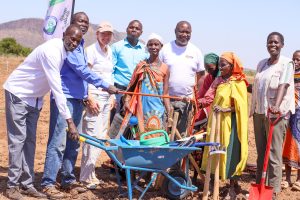
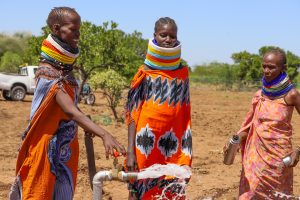
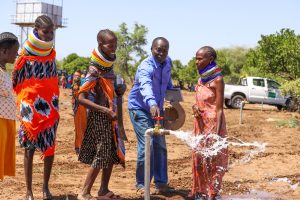
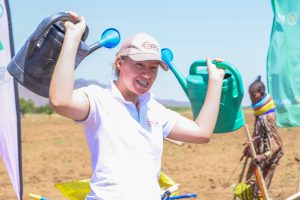
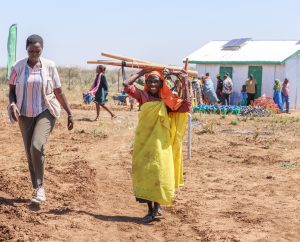
In a region that experiences hot and dry conditions year-round, this support is strengthening community resilience and enabling pastoralist households to sustain their livelihoods even during prolonged droughts. Farmers also received training in agroecology, equipping them with climate-smart skills for long-term impact.
For decades, the Turkana of Kenya and the Nyangatom and Dassanach of Ethiopia have lived at the edge of survival. Borders had become markers of tension, grazing lands contested, and a single raid could ignite cycles of revenge lasting generations.
Climate stress, shrinking pasture, porous borders, and the proliferation of small arms have over the years turned everyday life into a gamble with violence.
But one weekend at the beginning of 2026, in Omorate, something extraordinary happened: the sound of gunfire was replaced with songs and built hope for a chance for peaceful co-existence.
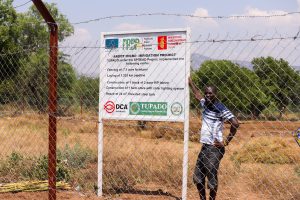
The Transboundary Peace Advocacy Campaign was supported through the European Union funded ‘Strengthening Integrated Peace, Resilience and Disaster Risk Reduction (SPREAD) project, implemented by DanChurchAid in Kenya and Ethiopia, together with partners Tupado and the Ethiopian Catholic Church Social and Development Commission (ESS-SDCO).
The campaign brought together leaders, youth, women, elders, and security actors from both sides of the Kenya-Ethiopia border, not to negotiate from a distance, but to meet face to face, speak truth, and reclaim shared humanity.
There is no progress in conflict — a call from leadership
Opening the engagement, Mr. Bekele Lokoroma, South Omo Regional State Deputy Zonal Head of Security, stated that conflict is a huge contributor to underdevelopment and does not give a chance to improve situations.
“There is no progress in conflict. Stealing and violence only take us backwards. Peace allows us to share water, pasture, and even protect our wildlife together.”
Bekele Lokoroma, South Omo County Head of Security
His words were not abstract. He acknowledged the realities facing the region, especially the displacement of neighbouring communities like the Merille due to lake expansion, and urged compassion over exclusion. “Welcome them. Share with them. Live together. They are people, just like us, facing a situation beyond they ability to amend,” he urged.
In a region where scarcity often fuels hostility, this call reframed peace as shared survival, not weakness.
Omorate: Where old enemies sat as old friends
Holding the engagement in Omorate was symbolic.
This border town has long been associated with raids, fear, and separation. Yet during the campaign, Turkana and Dassanach youths, some previously divided by active conflict, reunited, ate together, shared stories, and spent nights under the same skies
Instead of planning raids, youths discussed how to reach peers still eager for violence and bring them into dialogue spaces. Peace, once confined to boardrooms, had moved where it mattered most: the kraals and grazing fields.
Peace that opens borders, markets, and schools
From the Kenyan side, Mr. Emmanuel Achuka, Ward Administrator, spoke of tangible change: “The peace we have initiated has opened our borders for business. Our children can go to school without fear.”
Yet his message was also a reminder: peace must deliver development. He highlighted urgent needs for schools and water services in remote kraals like Nang’usilng’atuny, reinforcing that peace without services is fragile.
Assistant County Commissioner Steve Juma (Kibish) echoed this, addressing the community in the local language: “Last year, there was no bloodshed. That is not a small thing.”
He reaffirmed the commitment of both governments to sustained dialogue, coordinated security, and cross-border cooperation, adding , “We are one community, only separated by borders.”
“We are one community, only separated by borders.”
Steve Juma, Assistant County Commissioner, Kibish
When a football replaced guns
Perhaps the most powerful moment apart from the speeches was at the football pitch.
A Sport-for-Peace match brought together cross-border traders and administrators in a game that ended in a 2–2 draw. There was no obsession with winning. Players exchanged jerseys, laughed, and embraced. The Dassanach and Turkana youth also took to the pitch in a friendly match that ended in a 2-1 win for the Dassanach youth. This was celebrated by all teams.
One footballer, Joseph Ekal, captured the spirit of the day: “Even when someone played rough against me, I did not respond with anger. Because at the end of the day, whoever wins, we remain brothers.”
For communities where young men are often mobilised into violence, this was a powerful reimagining of masculinity, strength, and rivalry.
“Even when someone played rough against me, I did not respond with anger. Because at the end of the day, whoever wins, we remain brothers.”
Joseph Ekal
For communities where young men are often mobilised into violence, this was a powerful reimagining of masculinity, strength, and rivalry.
The SPREAD approach: peace woven into livelihoods
What makes this intervention under the SPREAD project different is how peace is built.
Through the project, peacebuilding is not treated as a standalone activity, but woven into livelihoods, resilience, and local governance. The project works across the entire peace ecosystem, national and county governments, peace committees, kraal elders, youth and women groups, security actors, CSOs, and faith-based organisations
TUPADO Executive Director, Mr. Sammy Ekal, emphasized that the peace sought after will continue to opened doors for business, for friendship, and for dignity.”
His appeal was clear and urgent, “We pray that both governments fully own this initiative long after donor funding ends.”
This peace will ensure prosperity, let us guard it
Sammy Ekal, Executive Director, TUPADO
His appeal was clear and urgent, “We pray that both governments fully own this initiative long after donor funding ends.”
From songs to strategy: rewriting the story of the border
Traditional dances, peace songs, storytelling, and a vibrant peace caravan through town transformed Omorate into a living statement: peace is not just negotiated, it is also celebrated.
One Nyang’atom artist, Lotiono Nyaamuara, told the crowd:
“This is the biggest event I have ever performed in. Many people know my peace songs, but today I finally met my fans.”
He announced a new peace song dedicated to SPREAD, proof that culture remains one of the strongest vehicles for reconciliation.
A fragile peace, a shared responsibility
The Turkana–Dassanach conflict did not emerge overnight, and it will not disappear overnight either. But the events in Omorate showed what is possible when communities are trusted, youth are engaged, women are included, and peace is linked to everyday survival.
Dollo Ado, Ethiopia - July 21
The Building Opportunities for Resilience in the Horn of Africa (BORESHA-NABAD) team in Ethiopia, from consortium partners Danish Refugee Council and the Rural Agency for Community Development and Assistance (RACIDA), participated in a high-level stakeholder review workshop hosted by the DRC Ethiopia Area Office in Dollo Ado. The session brought together government stakeholders from regional, zonal, and woreda levels, as well as key local partners.
The workshop served as a platform for stakeholders to review achievements, share lessons, and gather feedback aimed at informing adaptive programming. The BORESHA-NABAD team shared updates on implementation progress, strategic priorities, and plans aligned with government-led efforts in animal health, climate-smart agriculture, income generation, and peacebuilding.
Stakeholders commended the programme’s inclusive systems approach, which was noted for its community-driven, facilitative design. The approach seeks to strengthen local systems and promote sustainability across the borderlands of Ethiopia, Somalia, and Kenya.
“From the testimonies shared by our Woreda staff, we are pleased to learn that BORESHA is highly consultative and closely aligned with government initiatives. What stands out even more is its strong commitment to locally led solutions and its emphasis on strengthening systems through partnerships, rather than relying on a direct delivery model,” said a representative from the Somali Regional Government.
Funded by the European Union, BORESHA-NABAD is part of the broader EU Peaceful and Resilient Borderlands Initiative, which supports cross-border resilience and peacebuilding efforts in Kenya, Somalia, and Ethiopia. In Ethiopia, the programme is implemented by the Danish Refugee Council in partnership with RACIDA.
The Peaceful and Resilient Borderlands Programme (PRBP) has successfully conducted the first cross-border coordination forums in Moyale and Mandera clusters, which targeted the establishment and hosting of cross border steering committees.
The Peaceful and Resilient Borderlands Programme (PRBP) is a Multi-Donor Action: Support for Enhanced Effective Coordination of Peaceful and Resilient Borderlands for below IGAD border clusters.
♻️ Karamoja Cluster
♻️ Mandera/Somali Triangle Cluster and
♻️ Moyale/Moyale Cluster
The program focuses on the Horn of Africa region, particularly within the IGAD clusters covering Ethiopia, South Sudan, Somalia, and Kenya. Notably, these countries share common socio-economic and cultural ties but also face challenges such as conflict, migration, climate change, and underdevelopment.
The overarching program’s objective is to reduce the impact of local conflicts in the borderlands and enhance resilience in three IGAD clusters of the Horn of Africa.
The program will specifically reinforce coordination on cross-border management, including local authorities and IGAD as well as intensify sharing of information to mitigate conflict and promote socio-economic development.
The Peaceful and Resilient Borderlands program will answer to below thematic outputs:
✅ Cross-border coordination by identifying and supporting IGAD structures.
✅ Raising awareness on cross-border policies with national governments, local authorities, private sector and civil society in the 3 IGAD Clusters.
✅ Strengthening the management of transboundary resources.
✅ Coordination of components and clusters by establishing and hosting steering committees and other coordination mechanisms such as developing and conducting monitoring and evaluation.
Avenue Georges Clemenceau Djibouti, Republic of Djibouti P.O. Box: 2653 Email: prbpcoordiantion@igad.int TEL: +251 21 33 02 12
Join Our Community
Stay ahead of the curve with the latest news across the horn of Africa!
Co-financed by the European Union and the German Federal Ministry for Economic Cooperation and Development (BMZ), and implemented by GIZ (Deutsche Gesellschaft für Internationale Zusammenarbeit) in partnership with IGAD.

The Peaceful and Resilient Borderlands Program (PRBP) is jointly co-financed by the European Union (EU) and the Federal Ministry for Economic Cooperation and Development (BMZ) and implemented by Deutsche Gesellschaft für Internationale Zusammenarbeit (GIZ) GmbH as part of the Strengthening the Capacities of IGAD to Increase Resilience in the Horn of Africa Project (GIZ SCIDA III) in close collaboration with The Intergovernmental Authority on Development (IGAD).
The Peaceful and Resilient Borderlands Programme (PRBP) has successfully conducted the first cross-border coordination forums in Moyale and Mandera clusters, which targeted the establishment and hosting of cross border steering committees.
The Peaceful and Resilient Borderlands Programme (PRBP) is a Multi-Donor Action: Support for Enhanced Effective Coordination of Peaceful and Resilient Borderlands for below IGAD border clusters.
♻️ Karamoja Cluster
♻️ Mandera/Somali Triangle Cluster and
♻️ Moyale/Moyale Cluster
The program focuses on the Horn of Africa region, particularly within the IGAD clusters covering Ethiopia, South Sudan, Somalia, and Kenya. Notably, these countries share common socio-economic and cultural ties but also face challenges such as conflict, migration, climate change, and underdevelopment.
The overarching program’s objective is to reduce the impact of local conflicts in the borderlands and enhance resilience in three IGAD clusters of the Horn of Africa.
The program will specifically reinforce coordination on cross-border management, including local authorities and IGAD as well as intensify sharing of information to mitigate conflict and promote socio-economic development.
The Peaceful and Resilient Borderlands program will answer to below thematic outputs:
✅ Cross-border coordination by identifying and supporting IGAD structures.
✅ Raising awareness on cross-border policies with national governments, local authorities, private sector and civil society in the 3 IGAD Clusters.
✅ Strengthening the management of transboundary resources.
✅ Coordination of components and clusters by establishing and hosting steering committees and other coordination mechanisms such as developing and conducting monitoring and evaluation.